


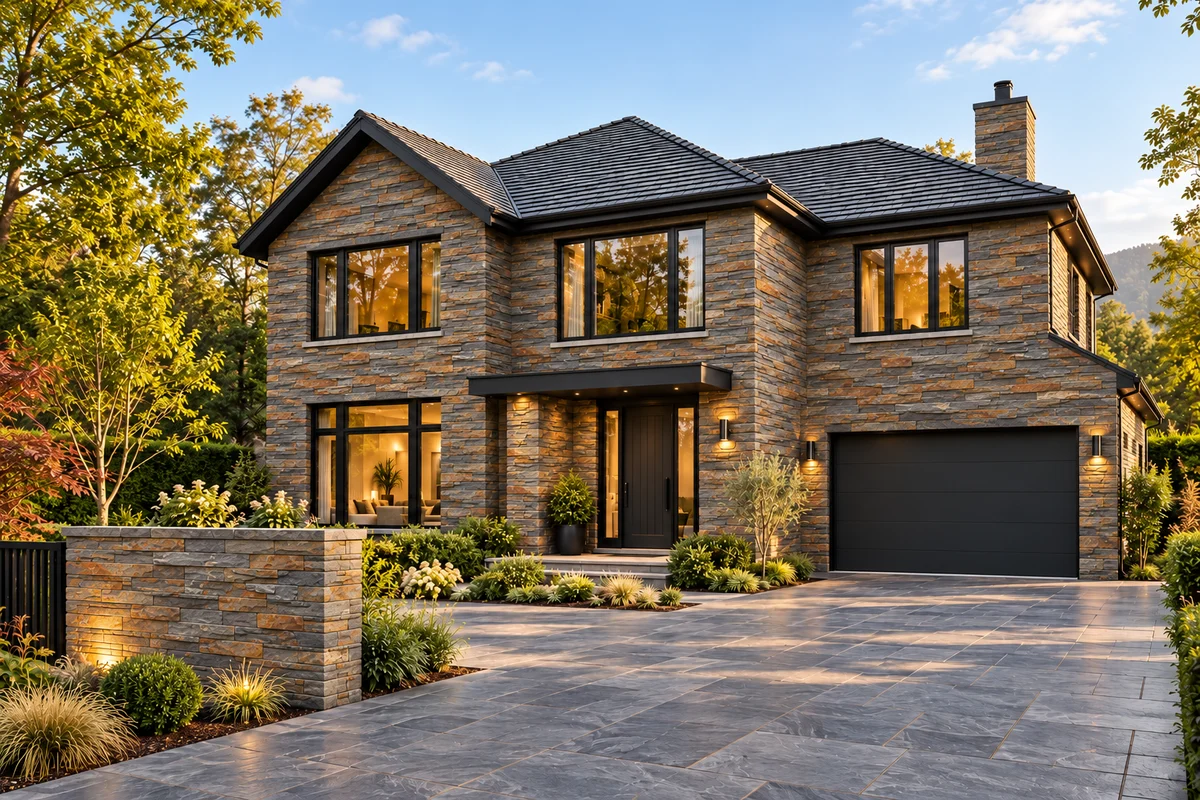
Slate is used for roofing, floor tiles, wall cladding, garden paving and architectural details. It is also used for products such as serving boards, writing slates and billiard-table beds. For building projects, the right slate depends on its properties, thickness, surface finish and intended exposure—not simply its colour. Natural Stone Council material overview
What Makes Slate Useful?
Slate is a metamorphic rock with a structure that allows it to split into relatively thin sheets. This makes it useful for roof coverings, tiles and decorative wall pieces.
Its appearance varies considerably. Some slate has a fine, even surface, while other varieties show pronounced layers, rust-coloured markings or contrasting veins. Grey, black, green and purple tones are among the available natural colours.
Slate also varies in hardness and weathering behaviour. Two stones sold under the same broad material name may perform differently, so selection should consider the actual product rather than a general description of slate. Natural Stone Institute: Slate Explained
1. Slate Roofing
Roofing is one of slate’s best-known applications. Individual roofing slates overlap to form a roof covering with visible courses and a natural stone finish.
Rectangular pieces create regular lines, while rounded or shaped lower edges produce a different roof pattern. These details can suit both traditional buildings and contemporary residential designs.
Roofing slate must be selected for roofing use. The specification should address the stone, dimensions, thickness, roof pitch, overlap and fixing method. A decorative wall tile should not automatically be treated as a suitable roofing product. NCS Slate Roofing Installation Manual
See an example of natural slate roof tiles with rounded lower edges.
2. Interior Flooring
Slate floor tiles bring natural texture and colour variation to entrances, hallways and living spaces. Darker tones can create a restrained background, while multicolour slate introduces a more varied surface.
The finish affects both appearance and everyday use. A strongly cleft face feels different underfoot from a smoother surface, and uneven tiles may require more attention during installation.
For flooring, compare several samples and confirm thickness consistency, surface suitability and maintenance requirements. Wet areas require particular care: a textured appearance alone does not establish slip resistance.
3. Wall Cladding and Feature Walls
Slate wall cladding can be used on building facades, entrance walls and interior feature walls. Its layered surface becomes especially noticeable under side lighting.
Different product forms create different effects:
- Flatter slate tiles produce a more regular wall surface.
- Raised-face mushroom stone creates stronger relief and shadows.
- Narrow stone pieces can form a layered horizontal composition.
Choose the form that matches the design. Individual mushroom stones and preassembled stone panels are different products and should not be specified interchangeably.
Explore a slate wall-cladding sample with a raised face.
4. Garden Paving, Paths and Steps
Suitable slate can be used for patios, garden paths, stepping stones and landscape details. Natural colour variation can connect paved areas with planting, timber and other stone surfaces.
Outdoor suitability must be confirmed for the selected material. Relevant considerations include expected loads, thickness, drainage, wet-surface behaviour and local climate. In cold locations, request appropriate evidence of freeze–thaw performance rather than assuming every slate is suitable outdoors.
Slate can serve many interior and exterior purposes, but material selection, fabrication and installation should be considered together. Natural Stone Institute: Slate Selection and Installation
Other Uses of Slate
Beyond construction, slate has been used for writing boards, decorative objects, serving pieces and precision-ground billiard-table beds. These uses require different finishes and manufacturing processes. A building tile is not automatically suitable for food contact or precision applications. NCS: The Many Uses of Slate
How to Choose Slate for Your Project
Start with the intended application, then select the appearance.
| Application | Product to consider | Details to confirm |
|---|---|---|
| Pitched roof | Roofing slate | Roof design, dimensions, overlap and fixings |
| Interior floor | Slate floor tiles | Thickness, surface finish and maintenance |
| Feature wall | Slate tiles or mushroom stone | Relief, layout, corners and installation system |
| Garden paving | Slate suitable for exterior paving | Loading, drainage, slip resistance and exposure |
Review multiple physical samples before approving a colour range. For a supply enquiry, provide the product reference, dimensions, quantity, intended location and drawings where available.
Browse Diancheng Stone’s natural slate collection to compare slate tiles, wall-cladding products and roof tiles.
Frequently Asked Questions
Can slate be used outside?
Yes, selected slate products can be used outdoors. Confirm suitability for the location, climate, installation system and intended use.
Is slate used for walls or floors?
Both. Flatter tiles are commonly considered for floors and walls, while strongly raised mushroom stone is intended for decorative wall surfaces.
Is all slate suitable for roofing?
No. Roofing requires slate selected and specified for that purpose. Wall-cladding and paving products should not be substituted without verification.